REAL WORLD CREATURES
GIANT SQUID
(Architeuthis dux)
Val	CHA	Cost	Roll	Notes
30	STR	20	15-	Lift 1600 kg; 6d6 HTH Damage [3]
18	DEX	16	13-
20	CON	10	13-
8	INT	-2	11-	PER Roll 13-/15-
5	EGO	-5	10-
20	PRE	10	13-	PRE Attack:  4d6

6	OCV	15
6	DCV	15
2	OMCV	-3
2	DMCV	-3
3	SPD	10		Phases:  4, 8, 12

10	PD	6		Total:  10 PD (2 rPD)
6	ED	2		Total:  6 ED (2 rED)
12	REC	8
40	END	4
23	BODY	13
50	STUN	15		Total Characteristic Cost:  117

Movement:	Running:	0m
		Leaping:	0m
		Swimming:	8m/16m

Cost	Powers & Skills
6	Tough Hide:  +2 PD, Resistant (+½) plus +2 ED, Resistant (+½)
15	Beak:  HKA 1d6 (3d6 w/STR), END 1
20	Soft Body:  Physical Damage Reduction, Resistant, 50%; Only Versus Guns And Most Other Ranged Attacks (-½)
12	Heavy:  Knockback Resistance -12m
3	Aquatic:  Life Support  (Safe in High Pressure; Safe in Intense Cold)
0	Only Swims:  Leaping -4m
0	Only Swims:  Running -12m
2	Aquatic:  Swimming +4m (8m/20m total), END 1
4	Water Jets:  Swimming +12m (8m/20m total); Straight Line Movement Only (-½), END 1
10	Tentacles:  Clinging (normal STR)
6	Sharp Senses:  +2 PER with all Sense Groups
4	Sharp Eyesight:  +2 PER with Sight Group
3	Sharp Eyesight:  +2 versus Range Modifier for Sight Group
6	Tentacles:  Extra Limbs (10 total), Inherent (+¼)
14	Tentacles:  Reach +13m (14m total)

	Skills
8	+4 OCV with Grab

5	Stealth 14-

Total Powers & Skill Cost:  118
Total Cost:  235

175+	Matching Complication (50)
15	Hunted:  Sperm Whales Infrequently (Mo Pow; Harshly Punish)
20	Physical Complication:  Animal Intelligence (Frequently; Greatly Impairing)
15	Physical Complication:  Enormous (mantle length upwards of 3m, tentacles upwards of
	14m, +4 OCV to hit, +4 to others PER Rolls to Perceive) (Frequently; Slightly Impairing)
20	Physical Complication:  Very Limited Manipulation (Frequently; Greatly Impairing)

Total Complication Points:  50
Experience Points:  60
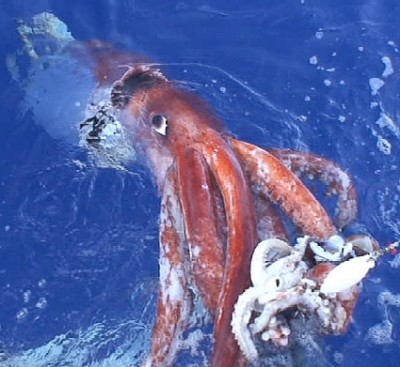
Ecology: Giant Squid seem to live at depths of about 1,000 to 6,000 feet, although this is not certain. It is known that they avoid the surface—unless sick or dying—although some giant squid have been washed ashore after great storms. Three of the more common places to find giant squid are Newfoundland, New Zealand, and Norway.
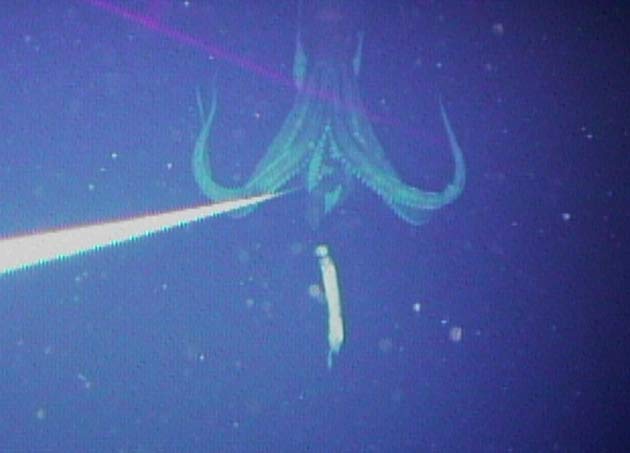
Giant squid prey on fish, small sharks, skates, shell fish and other squids. It is not know how they hunt, how long they live (some estimates put this at 3-5 years) or how they breed. Until 2004, no one had ever seen a living giant squid in the wild. On September 30, 2004, researchers from the National Science Museum of Japan and the Ogasawara Whale Watching Association took the first images of a live giant squid in its natural habitat. Several of the 556 photographs were released a year later. The same team successfully filmed a live giant squid for the first time on December 4, 2006. It is unknown how large the giant squid can get—lengths of 100 feet or more have been ascribed to it. It is also said to be capable of pulling ships to the bottom. For example, the Norwegians believed in the Kraken, a squid reported as being over a mile in circumference.
Personality/Motivation: Typical animal motivations.
Powers/Tactics: As giant squid are neutrally buoyant, it is presumed that they float motionless in the water and wait for prey to blunder into their long tentacles (at which point prey is dragged to the beak). However, footage shot in 2004 shows the squid to be an active predator, and it may pursue prey as opposed to waiting for something to blunder into the range of its tentacles. Giant squid may hunt near the surface, and there have been a few cases of giant squid attacking boats (usually after being prodded by occupants in said boat.) At least one report described two men being snatched from the side of a becalmed ship in the Indian Ocean, while another states that a giant squid grabbed a man off of a floating bit of wreckage during World War II. If injured the squid will jet away quickly, and unlike its smaller relatives, the giant squid's ink sacks are very small and don't produce clouds of ink equal to its size.
Appearance: The giant squid is the longest living invertebrate (and possibly the longest ever). The largest squid ever recorded weighed about 1,900 pounds (or more) with a mantle length of 10 feet and tentacles that were upwards of 45 feet long. The longest known giant squid was a full 57 feet long from the end of the mantle to the tips of the longest tentacles. Giant squids are a reddish or purplish color, with a thick mantle and two large eyes that can be up to 10" across. They have 8 short tentacles and two long whip-like tentacles. The suckers lining these tentacles are equipped with numerous small hooks and are can be up to 1 inch across.
Designer's Notes: Until 2004, the giant squid was the largest known animal that no one had ever seen in the wild. It was only known by dredged up specimens and bodies that had washed ashore. In addition, although the giant squid is the longest invertebrate, there is a larger and heavier one—the colossal squid (Mesonychoteuthis hamiltoni.) Estimated to reach lengths of 46 feet, the largest known specimen is 33 feet long and weighs 1,091 pounds.
Recommended Reading: Ellis, Richard. Monsters of the Deep. Print.
Ellis, Richard. The Search for the Giant Squid. New York, N.Y.: Lyons, 1998. Print.
Giant Squid Hero Designer File
Return to Real World Creatures