REAL WORLD CREATURES
GREAT WHITE SHARK
(Carcharodon Carcharias)
Val	CHA	Cost	Roll	Notes
35	STR	25	16-	Lift 3200 kg; 7d6 HTH Damage [3]
15	DEX	10	12-
25	CON	15	14-
8	INT	-2	11-	PER Roll 12-/14-
5	EGO	-5	10-
25	PRE	15	14-	PRE Attack:  5d6

5	OCV	10
5	DCV	10
2	OMCV	-3
2	DMCV	-3
3	SPD	10		Phases:  4, 8, 12

13	PD	8		Total:  13 PD (3 rPD)
11	ED	6		Total:  11 ED (3 rED)
12	REC	8
50	END	6
23	BODY	13
55	STUN	18		Total Characteristic Cost:  127

Movement:	Running:	0m
		Leaping:	0m
		Swimming:	8m/16m

Cost	Powers & Skills
25	Bite:  HKA 1 ½d6 (3d6+1 w/STR), +1 Increased STUN Multiplier (+¼); Reduced Penetration (-¼), END 3
8	Heavy:  Knockback Resistance -8m
9	Tough Hide:  Resistant Protection (3 PD/3 ED)
0	Only Swims:  Leaping -4m
0	Only Swims:  Running -12m
1	Cruising Speed:  Reduced Endurance (0 END; +½) applied to Swimming
2	Attack Speed:  Swimming +4m (8m/26m total), END 1
4	Sudden Burst Of Speed:  Swimming +18m; Increased Endurance Cost (x4 END; -1 ½), END 4
22	Ampullae Of Lorenzi:  Detect Electrical Fields 11-/12- (Unusual Group), Range, Sense, Targeting
5	Acute Sense of Smell:  Discriminatory with Normal Smell
3	Sharp Senses:  +1 PER with all Sense Groups
4	Sharp Senses:  +2 PER with Smell/Taste Group
18	Lateral Line:  Spatial Awareness (Touch Group), Increased Arc Of Perception (360 Degrees);
	To Detect Motion Only (-½)
10	Acute Sense of Smell:  Tracking with Smell/Taste Group

	Skills
8	+4 OCV with Bite

3	Stealth 12-
7	Tracking 12-

Total Powers & Skill Cost:  130
Total Cost:  256

175+	Matching Complications (50)
20	Hunted:  Man Frequently (Mo Pow; Harshly Punish)
20	Negative Reputation:  Man-eating shark, Very Frequently (Extreme)
20	Physical Complication:  Animal Intelligence (Frequently; Greatly Impairing)
15	Physical Complication:  Enormous (roughly 6-8m long,  1700-1850 kg, +4 OCV to hit, +4 to others
	PER Rolls to Perceive) (Frequently; Slightly Impairing)
20	Physical Complication:  Very Limited Manipulation (Frequently; Greatly Impairing)
15	Psychological Complication:  Always Hungry, Goes Out Of Its Way To Find Food (Common; Strong)
10	Susceptibility:  to not moving in water; 1d6 damage per Turn (Uncommon)

Total Complications Points:  50
Experience Points:  81
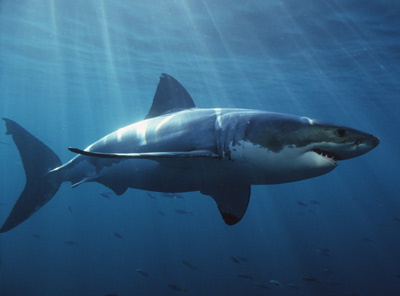
Ecology: White Sharks live in cool waters the world over. They eat almost anything that swims, including seals, sea lions, skates, rays, other sharks, penguins, fish, carrion (such as floating whale carcasses), and (very rarely) people. The primary prey for large Great Whites seems to be seals (including fur seals, sea lions. and elephant seals), and anywhere these mammals gather to roost one can expect to find large quantities of White Sharks. They are diurnal, being active during the day and are probably shallow water animals, remaining in the upper 300' of the ocean. The areas most commonly frequented by White Sharks is the San Francisco Bay area, Southern Australia, and South Africa.
At a best guess, White Sharks give birth to one live pup at a time. A pup is a 4 feet long and ready to eat anything it can catch. Young white sharks are far much faster than the one presented here (which is meant to represent a 3200-pound boat-wrecking monster) with more base inches of swimming. White Sharks mature slowly and probably live for 20 years or more.
It is commonly believed that Great White Sharks can reach lengths of up to 36 feet, although this seems to be based on an error in reporting the size of a certain great white catch (the animal was more like 17 feet long.) There are some who believe that Megalodon, a 45+ foot relative of the Great White Shark, may still exist. Popular theory also holds that a shark can go "rogue," developing a taste for human flesh and remaining in an area where it is readily available.
The Great White Shark is known by many names around the world, including: Blue Pointer, Jaws, Man-eater, Uptail, Tommy, White Death, White Pointer, and White Shark.
Personality/Motivation: Typical animal motivations.
Powers/Tactics: White Sharks are attracted to food or food-like items. They tend to attack by rushing their prey, striking with a destructive bite of their massive jaws and then withdrawing to wait for their prey to bleed to death. This seems to be why so few people are actually eaten by Great Whites. Once the shark strikes, it releases its victim, and waits for it to die. Since most people are swimming with others, they are pulled out of the water before death occurs.
Prior to striking, a shark may bump its target, possibly to see if it really is a food item. The Ampullae of Lorenzi enable a shark to detect weak electrical fields (created by all living things, but far more detectable in water.) and by bumping a target it may be able to determine what the object is. Note that metal objects (such as boat propellers, cages, and ship's hulls) will disrupt this field, causing the shark to bite at nonfood items (such as cages, propellers, and other metal objects). Sharks can also use the Ampullae of Lorenzi to find fish buried in the sand, such as skates, rays, and flatfish.
A White Shark will rush its target and quickly bite down, closing its jaws in 1.7 to .76 seconds (hence the +4 OCV). It will then shake its victim before letting go. If the target is a large unmoving object (such as a whale carcass) the shark will twist itself about and carve out a chunk of flesh that can weigh 40 pounds or more (Great Whites have swallowed 300+ pound seals whole!) The wound is very large, ragged and bleeds profusely (thus the Increased Stun Modifier). Once the prey is fully incapacitated, the shark will circle back around and finish it off in a few gulps.
Great Whites do not run unless confronted by a larger shark (and maybe not even then). They are at the top of the food chain and normally aren't preyed on by anything (except man.) Of course, if a large elephant seal puts up enough of a defense (and a large male elephant seal may mass 6,000 pounds) the shark will leave.
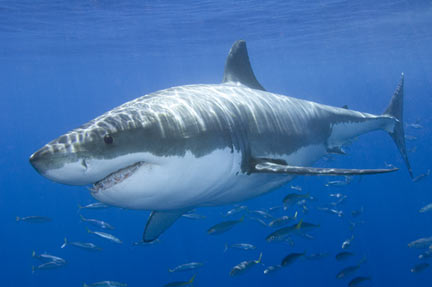
Appearance: A Great White Shark is possibly the most "shark-like" of all sharks (Although the Blue Shark is probably the best "generic-looking" shark.) It has a blunt snout, broad pectoral fins, a tall dorsal fin, and almost perfectly symmetrical caudal fins. It is a grayish color along the back and pale white along the stomach. The eye is a dull black circle. A White Shark's teeth are very large, reaching lengths of over 1.5" and sharply serrated.
When full grown the Great White Shark is a massive animal—the largest large-prey predatory fish in existence. Great Whites can reach lengths of 19-21 feet (with the possibility of 23 feet) and mass upwards of 3,940 pounds or more (some have been weighed at over 4,000 lbs). The smallest White Sharks are newborns, which at 41" and 28 pounds, are still bigger than 75% of all sharks in existence.
Designer's Notes: This is the Great White Shark, brought to life in Peter Benchly's thriller Jaws and Steven Spielberg's blockbuster of the same name. The character sheet is an attempt to capture the real abilities of the Great White, which are exceedingly impressive.
Recommended Reading: Ellis, Richard, John E. McCosker, and Al Giddings. Great White Shark. New York, NY: HarperCollins in Collaboration with Stanford UP, 1991. Print.
Ellis, Richard. The Book of Sharks. New York: Alfred A. Knopf, 1989. Print.
Matthiessen, Peter. Blue Meridian: the Search for the Great White Shark. New York, N.Y., U.S.A.: Penguin, 1997. Print.
Great White Shark Hero Designer File
Return to Real World Creatures