REAL WORLD CREATURES
CROCODILE
(Crocodylus niloticus [Nile]
Crocodylus porosus [Saltwater])
Val	CHA	Cost	Roll	Notes
30	STR	20	15-	Lift 1600 kg;
				6d6 HTH Damage [3]
15	DEX	10	12-
23	CON	13	14-
8	INT	-2	11-	PER Roll 13-
5	EGO	-5	10-
23	PRE	13	14-	PRE Attack:  4 ½d6

5	OCV	10
5	DCV	10
2	OMCV	-3
2	DMCV	-3
3	SPD	10		Phases:  4, 8, 12

14	PD	8		Total:  14 PD (4 rPD)
10	ED	6		Total:  10 ED (2 rED)
11	REC	7
46	END	6
18	BODY	8
45	STUN	13		Total Characteristic Cost:  118

Movement:	Running:	12m/24m
		Leaping:	see below
		Swimming:	12m/24m

Cost	Powers & Skills
20	Bite:  HKA 1 ½d6 (3 ½d6 w/STR); Reduced Penetration (-¼), END 2
12	Tail Lash:  HA +3d6, Reduced Endurance (0 END; +½); Only With Extra Limb (-½),
	Hand-To-Hand Attack (-¼)
8	Heavy:  Knockback Resistance -8m
9	Tough Hide:  Resistant Protection (4 PD/2 ED)
2	Faster Then It Looks:  Running 4m; Increased Endurance Cost (x4 END;-1 ½), END 4
0	No Leaping On Land:  Leaping -4m
2	Lunging:  Leaping 10m; Forward Movement Only (-1), Must Start in Water (-½), No
	Noncombat Movement (-¼), END 1
1	Lunging:  Leaping 2m; Upward Movement Only (-1), Must Start in Water (-½), No
	Noncombat Movement (-¼), END 1
4	Aquatic:  Swimming +8m (12m total), END 1
12	Sharp Senses:  +4 PER with all Sense Groups
5	Tail:  Extra Limb (1), Inherent (+¼); Limited Manipulation (-¼)
16	Submerged Body:  Invisibility to Sight Group, Reduced Endurance (0 END; +½), Persistent (+½);
	Only While In Water (-½), Only Versus Viewers Near Water Level (-½), Chameleon (-½)
1	Tail:  Reach +1m (2m total)

	Skills
16	+2 with HTH Combat
4	+2 with Grab

7	Concealment 14-; Self Only (-½)
5	Stealth 13-
9	Tracking 13-

TTotal Powers & Skill Cost:  124
Total Cost:  241

175+	Matching Complications (50)
15	Negative Reputation:  large and dangerous reptile, man-eater, Frequently (Extreme)
20	Physical Complication:  Animal Intelligence (Frequently; Greatly Impairing)
15	Physical Complication:  Enormous (roughly 7m long, 997 kg, +4 OCV to hit, +4 to others PER Rolls
	to Perceive) (Frequently; Slightly Impairing)
20	Physical Complication:  Very Limited Manipulation (Frequently; Greatly Impairing)
10	Psychological Complication:  Aggressive And Territorial (Common; Moderate)

Total Complications Points:  50
Experience Points:  66
Ecology: Crocodiles live in and near water, and are commonly found in Africa, America, Asia, and Australia. The crocodiles represented by this character sheet are the Nile and Saltwater (a.k.a. Indo-Pacific or “Saltie”) crocodiles, which are found in the Nile River, and rivers along the coast of Australia and portions of southeast Asia. The Saltwater Crocodile is also known for its seagoing habits, and has been found in fairly deep water, feeding on sharks and turtles. In general, crocodiles are river dwellers, although they will make their home in marshes and swamps as well. They can (and will) prey on nearly anything, and will feed on birds, fish, other crocodiles, various reptiles and amphibians, and a wide variety of mammals, ranging in size from small antelope to large wildebeest. Crocodiles are also known to be man-eaters, and do so with some regularity. It is estimated more than 1000 people are killed and eaten each year by crocodiles in Africa.
Personality/Motivation: Typical animal motivations. It should be noted crocodiles can be fairly aggressive animals, and male crocodiles can be very territorial. Crocodiles are known to attack canoes and small boats equipped with outboard motors; it is thought these attacks are due to the crocodile thinking the canoe or boat is an intruding larger crocodile.
Powers/Tactics: Crocodiles hunt by lying in wait along the surface of the water. They typically submerge all but their eyes and nostrils, and in this position are effectively invisible to anyone at water level (Those under the water, or high above the river, will be able to see the crocodile with much less difficulty.). In this position they’ll wait motionless, waiting for a potential prey item to appear. The crocodile will then fully submerge, resurfacing periodically to track its prey, until it’s close enough to lunge out of the water and grasp its prey in its jaws (se the rules for Grab on page 39 of the HERO System Bestiary.) They crocodile will then hold on with its mouth, drag its prey into the water, and then spin, attempting to drown its prey as it tears off a great mouthful of flesh. Due to its strength and power, crocodiles can lunge up to 30 feet out of the water and up a beach to strike. They can also leap up to five feet vertically, snatching prey off of an overhanging bridge, dock, or branch. Both forms of leap require the crocodile to start out in water, using its tail to propel itself upwards and out. As a final note, crocodiles are not slow and sluggish, although they do spend a lot if time conserving energy by basking. They can outrun a man both in and out of the water, and are very fast over short distances. The best way to view a crocodile is from a safe, elevated vantage point and with a pair of binoculars.
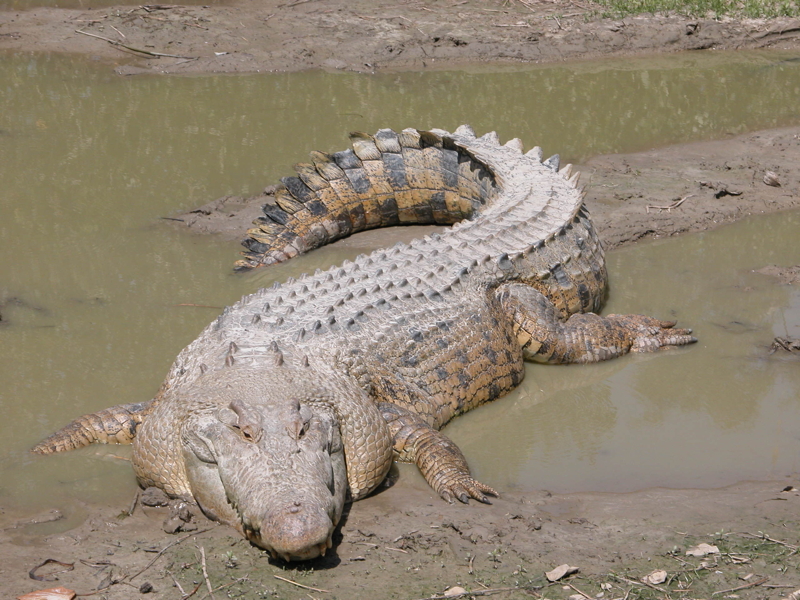
Appearance: Crocodiles are large reptiles with long, narrow heads, wide bodies, and powerful tails. They are bluish- or greenish-gray in color, with heavily scaled and armor-plated hides. The Nile crocodile can reach weights of 2,200 lbs and lengths of 21 feet, while the Saltwater crocodile can exceed 23 feet.
Designer's Notes: The crocodile is probably one of, if not the most efficient predators on the planet (the Great White Shark is its main competitor). It kills more people each year than any other large animal, and is found worldwide.
Recommended Reading: Matthews, Richard. Nightmares of Nature. London: HarperCollins, 1995. Print.
Return to Real World Creatures